A Small Blog

Looking at Life in Small Pieces

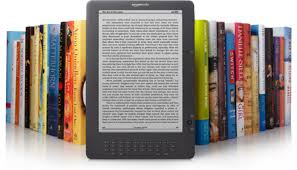
  • kindle and booksThis is a little list of some of the books I’ve recently read–mostly while sitting in hospital rooms or doctors’ waiting rooms. My husband had two episodes of seizures, one in November and one in January. He spent a some time in the hospital and subsequently at various doctors’ offices. Many tests were done and no particular medical reason has yet been established. Texas law dictates that after one has a seizure, one may not drive for three months. So, with Kindle in hand, I’ve been the designated driver. Titles comes with links to the books on Amazon, followed by short personal opines.

    Sistina by Brian Kenneth Swain  Not just because he is a friend, I say this is an excellent read. The link is to the review I wrote on Amazon. From there I recommend purchasing and enjoying.

    Station Eleven by Emily St. John Mandel This story interweaves in different and intriguing  ways from other post-apocalyptic books I’ve read. It’s sweet, suspenseful and leaves you with hope for the human race. And, yes, I am drawn to that particular genre.

    Marco Polo-The Journey that changed the world by John Man  I bought this nonfiction book after watching the Netflix Marco Polo series–with naked women ninjas and other such highly suspect re-enactments of Marco’s life under the Khan. The author really dug (pun intended) into archaeological evidence, and tracked down a great deal of historical data. If you want the most true story of Marco Polo, read this.

    Colorless Tskuru Tazaki and his years of pilgrimage by Haruki Murakami I love this Japanese author. He writes enigmatic, intense character novels. This is his latest, but not greatest. Read Kafka on the Shore to be blown away.

    Wonderful Tonight by Pattie Boyd As a young woman, Pattie was married to Beatle George Harrison until Eric Clapton ‘stole’ her away. Were they matches made in heaven? Not quite. She led a very interesting life and tells it with great insight and candor, revealing the true personalities of two of the greatest music icons of my age.

    Gould’s Book of Fish  Magnificently written, fact-based fiction by Tasmanian author Richard Flanagan. Full of graphic imagery often written with wry sense of humor, it’s not for readers with tender constitutions. Still, if you want real literature, it’s a must read.
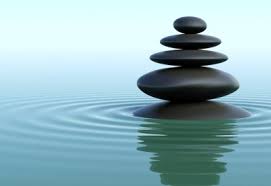
  • Several years ago I read this wonderful book “Sabbath, Restoring the Sacred Rhythm of Rest” by Wayne Muller, ordained minister, graduate of Harvard School of Divinity and therapist.

    In his introduction, Muller explains in a general, not accusatory way, how in the relentless busyness of modern life we have lost the rhythm between work and rest. He tells how we suppose action and accomplishment are better than rest, that doing something-anything-is better than doing nothing. Because of this, we don’t rest, we miss the quiet refuge that brings us wisdom, and we miss the joy and peace from our moments of rest.

    According to Wikipedia, the Sabbath is generally a weekly day of rest or time of worship. It is observed differently in Abrahamic religions and influences similar occasions in several other practices. Although many viewpoints and definitions have arisen over the millennia, most originate in the same textual tradition.

    In this book Muller encourages us to remember the Sabbath by living the rhythm of rest and gives meditations and  examples of how to incorporate ‘small’ Sabbaths into our everyday life in a variety of ways—that include setting aside quiet times, taking a walk in the park, lighting a candle and saying a blessing, enjoying a meal with friends.

    The following are a few passages that I hope will inspire you, as it did me, to find a quiet place, at any time, to remember the Sabbath as a divine gift of rest.

    Readings from the book

    In Genesis, a fundamental goodness is presumed throughout the creation story. At every juncture God acts, steps back and rests. “And God saw everything that he had made, and behold it was very good” Genesis 1:31 Sabbath rest invites us to step back and see that it is good.

    Mark 2:27, “You are not made for the Sabbath, the Sabbath is made for you.” Muller says, The Sabbath isn’t a responsibility, it’s a gift, and if we don’t take that gift, we all suffer. He tells us the point isn’t to take the Sabbath in order to avoid spiritual trouble with a cranky God who’s going to punish you. The point is to take Sabbath in order to be as nourished, fed and delighted as we’re meant to be. “Your life is not a problem to be solved but a gift to be opened.”

    meditation, stones, pond,prayerPrayer is like a portable Sabbath, when we close our eyes for just a moment and let the mind rest. Like the Muslims who stop to pray five time a day, like the Angelus we can be stopped by a sunset, a meal and we can pray. Something close to the heart, and simple.

    Sabbaths are filled with prayers. But we can begin slowly with a simple prayer like a pebble dropped into the middle of our day rippling out over the surface of our life. Perhaps a line from the 23rd Psalm, the Lord’s Prayer, a short blessing: “May all beings be happy and may all being be at peace.”

    A verse in the 23rd Psalm says “He makes me lie down in green pastures; he leads me beside the still waters. He restores my soul.” Even Jesus stepped back from his ministry and the crowds to a place of rest. In doing so he is honoring a deep spiritual need for a time dedicated not to accomplishment and growth, but to quiescence and rest.

    Better is one hand full of quietness than two hands full of toil and a striving after wind” Ecclesiastes 4:6 Traditional Sabbaths are filled with prayers. But we can begin slowly with a simple prayer like a pebble dropped into the middle of our day rippling out over the surface of our life.

    Mother Teresa said “Let us remain as empty as possible so that God can full us up.”At our best, we become Sabbath for one another. Not fixing, not harming, not acting, we can become space, that our loved ones, the lost and sorrowful, may find rest in us. ‘Where ever two or more are gathered, there am I in the midst of you.’ 

     The Desert Fathers counseled, “Go into your cell, and your cell will teach you everything.” Set aside a period of time in nature or at home, at a church or temple, a library or anywhere you will not be disturbed. Sit, meditate, pray, read, whatever pleases you. Pay attention.


  • estate saleI stopped in at an estate sale this morning in one of the larger homes in the neighborhood. Even though I had cleaned out my parents’ four bedroom home and been to many an estate sale, I can truly say I’ve never seen so much stuff in my life!

    I was fascinated and appalled all at the same time at the many, many things this family had collected over the years–antique furniture, toys, crystal, a dozen sets of dishes, an entire room of Christmas decorations, jewelry, books, clothes… An over abundance of ‘things’ in every sense of the word. Especially, when I try very hard to minimize and repurpose our belongings on a regular basis.

    It also reminded of this little story I wrote a few years ago for the Current’s Flash Fiction feature.


    I always knew my son and his family would have no use for my precious mementos after I am gone.  Bric-a-brac, knick-knacks, stuff!

    The furniture I inherited from my grandparents–a phone table with a little seat for comfortable chatting, the antique mantle. The beautiful set of china on which my mother served  holiday dinners that shaped generations of family gatherings.  I cherished these and many other family pieces passed down to me.  But, who wants a framed, handmade baby christening gown?

    My books are all going for a dollar.  People are rummaging through my clothes and linens–all which are permeated with the odor of stale perfume. Handbags and jewelry, luggage, kitchen appliances… A bowl full of sea shells or a scorched set of cooking pans–not treasures for sure. The estate sellers are doing their job of clearing the house for sale.  But, there’s no one there to tell the stories.

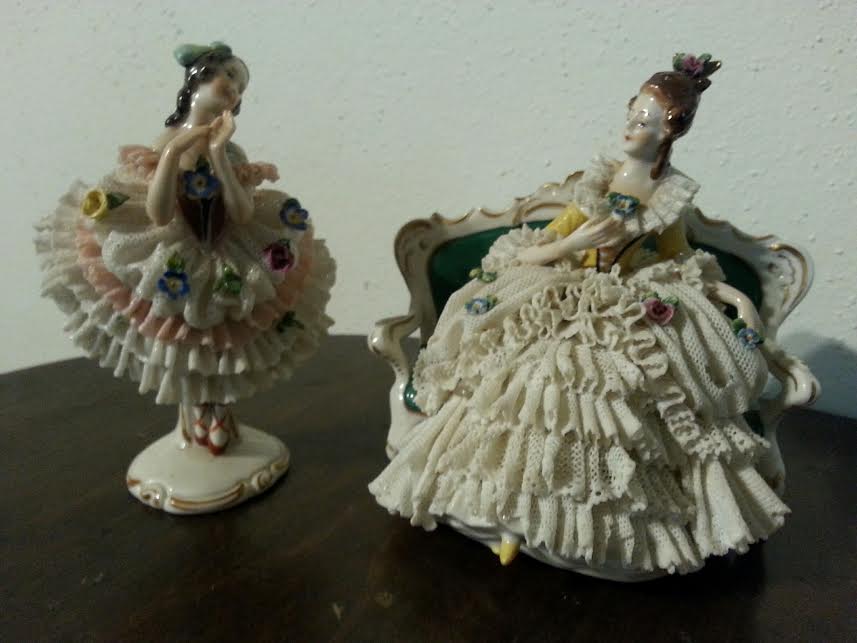
    dresden ladiesMany times I tried to tell the story behind the Dresden figurines. The ones in the glass cabinet that I stared at my whole life.  My parents bought those beautiful little ballerinas, with their tutus of delicate porcelain lace, in 1947 from a German family who had to sell their precious keepsakes to feed themselves. But, how could that matter now? Surely someone will see their value and give them a good home, where they can be admired everyday as a beautiful works of art. The finely etched beaten copper table top my father brought back from Pakistan when he served there in the ’50’s. The painting of the two devilish monks my first true love, George, gave me when I was 18 years old.

    After the good things go, it looks like the sad remnants of an inconsequential life. I hover over this scene, on my last pass through this world, the memories fade along with the disbursement of my possessions.  And, now I surely know the truth of ‘you can’t take it with you.’

  • Found on Pinterest
    Found on Pinterest

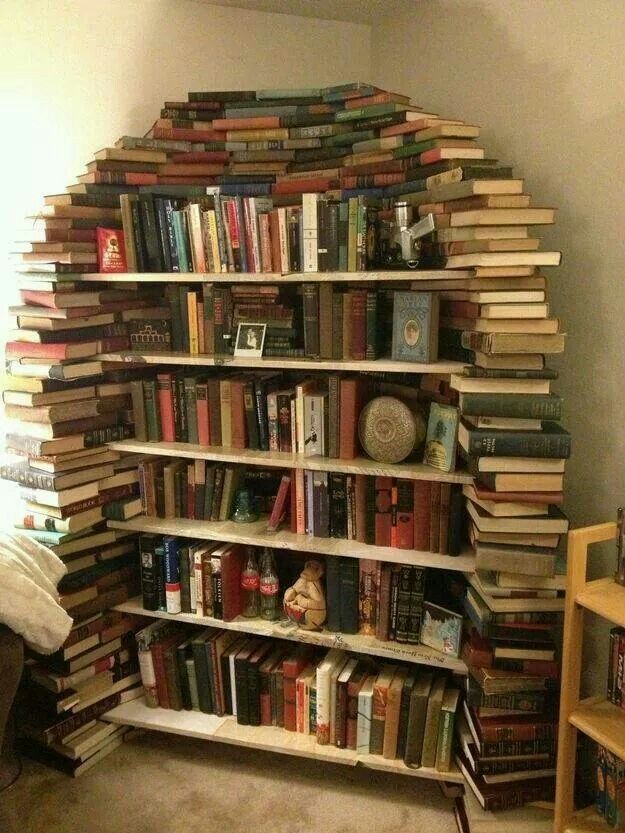
    I am a book hoarder. I always like to have many books stashed away–either on my shelves or in my Kindle–to read at some future time. The last few months, I made it a goal to read all the hardback books I’d been saving for retirement, plus a couple of library books.

    All of the following books are very good to excellent, except for the last one which was so-so–my opinions only. I’ve linked them to their page in Amazon for your convenience. Also, they are all over the map as far as genre is concerned.

    The Language of Flowers by Vanessa Diffenbuagh

    Oral History by Lee Smith (highly recommend though you may talk like a hillbilly in your head for a week afterward)

    The Periodic Table by Primo Levi

    The Wayfinders by Wade Davis (I wrote about this one already)

    Shoot an Iraqi by Wafaa Bilal and Kim Lydersen (not what you might think and very interesting)

    Same Kind of Different as Me by Ron Hall and Denver Moore

    The Boy in the Striped Pajamas by John Bayne (sad indicator at 10)

    Always Running: La Vida Loca: Gang Days in L.A. by Luis Rodriguez (read for banned book week)
     The Dog Stars by Peter Heller (library book, five star rating for post-apocalyptic genre)

    Purple Cane Road (Dave Robicheaux Book 11) by James Lee Burke (library book. I’m kinda hooked on James Lee Burke at the moment)

    Chasing the Night by Iris Johansen

    Let me know if you read any, how you like them.

  • Some time ago, both my husband and I made the decision to retire in the summer of 2014. In preparation for beginning this new phase in our lives, I did some reading on the subject. I came across some articles by Dudley Tower, PhD on his website Dynamic Aging Institute. According to Tower, “dynamic aging is a unique, systemic, more fully engaged, and proactive approach to one’s own aging process.” He states the retirement isn’t meant to be a “leisurely declining into oblivion.” And, the retiree should “…engage completely with life, develop fresh skills and qualities, and find creative new areas of your life…” I find this approach both validating and exhilarating.

    Among all the other changes and new adventures, it may seem a minor point, but one of my first challenges has been learning how to ‘sleep-in’. I put away my wristwatch the day I retired and no longer set the alarm at what I now perceive as a God-awful early hour. But, I still wake up about the same time as I always did when I was working and am unable to get back to sleep. The cat doesn’t help as he obviously has not changed his schedule for breakfast and going on his morning inspection of the yard.

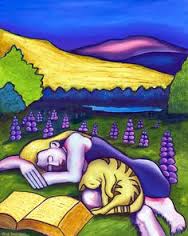
    asleep with a bookMy solution? I treat myself with naps. I cherish this new freedom to incorporate a nap into the day’s activities. I lie down in the quiet and close my eyes for as little as 20 minutes, or sometimes longer. My favorite way to nap is to bring a book and drift off reading.
    According to the Mayo Clinic website, napping offers these benefits for healthy adults, including:
    Relaxation
    Reduced fatigue
    Increased alertness
    Improved mood
    Improved performance, including quicker reaction time, better memory, less confusion, and fewer accidents and mistakes

    That works for me!

    And, now, that this post is done, excuse me while I go take a little nap.

  • Last night I went to a great music concert/fundraiser in Austin courtesy of my sister-in-law who works for Health Alliance for Austin Musicians or HAAM.

    The British Invasion of the 60’s was revisited by an eclectic procession of Austin/Texas/British musicians. It was a very entertaining musical history lesson and a whole bunch of fun!

    allatx playbill
    Click for full list of performers

    The Zombies (in the flesh!) sang this old Kinks tune. It really it made an impression on me, so I decided to share.

  • At any given time, I have about a dozen books on my shelf waiting for the right time to be read. So it was with “The Wayfinders-Why Ancient Wisdom Matters in the Modern World,” by Wade Davis, which had been waiting patiently for about three years. Once I’d read the first few pages, I gulped this book like it was a life-giving elixir.

    way finder book coverDavis begins by sharing his view of the world. And believe me, from his life experiences as a National Geographic explorer, writer and anthropologist, he is well versed in world. “Together the myriad of cultures makes up an intellectual and spiritual web of life that envelopes the planet and is every bit as important to the well being of the planet as is the biological web of life we know as the biosphere.” Davis calls this social web of life an ethnosphere — the “sum total of our thoughts and intuitions, myths and beliefs.” This ethnosphere is the core of our adaptive nature and our legacy.  And, the truth is we are facing the loss of half of humanity’s social, cultural and intellectual legacy, as the extinction of human cultures is picking up pace.

    Excellently written and thought provoking, this book is essentially a compilation of Davis’ series of Massey Lectures. Davis shares his extensive knowledge of a good many diverse populations with whom he developed relationships. First, the Polynesians, spreading their cultural realm to hundreds of islands throughout the Pacific with their amazing art of navigation. Who knew Thor Hyderdahl’s “Kon Tiki” was full of bunk! Peoples of the Anaconda is a perfect example of a large and diverse civilization whose existence is woven into the very fabric of its physical location–along the Amazon River. The Aborigines of Australia, with their ritual ‘dreaming,’ evolved a deep, timeless relationship with their world. “What does it mean that though out history “dynamic living people have been driven out of existence by identifiable and overwhelming external forces?” Davis asks.

    With a perfect blend of science and human insights, Davis makes  powerful observations. In the chapter on Sacred Geography he states, “…I would like to reflect on this particular attitude of ours, this manner in which we have reduced our planet to a commodity, a raw resource to be consumed at our whim.”  The modern world…”is certainly not the true and only pulse of history. It is merely a constellation, of beliefs, conviction, paradigm, that represent one way of doing things…”

    For some reason I thought of this song when I was writing this blog. In the vast oceans, we are but ripples and waves. But, as that, we part of the whole. We are past, present, and the future–if we don’t fuck it up.

    “I’m a wave upon the ocean, I’m a little ripple on the sea. Don’t get no crazy notion, you know you’re very much like me.” Shivas Headband

  • There have been so many cosmic and cool things in my life. And, I don’t care if anyone but me thinks so. But, listen to this one.

    The summer I was nineteen, I came back home to San Antonio from my freshman year at Southwest Texas State College. Just for something to keep me occupied, I accompanied my friend, Rosie Gander, to the San Antonio Little Theatre. We signed up to volunteer as stagehands for their big summer show–“Sound of Music”–staged at the old Sunken Gardens outdoor theater.

    I met an airman there who was also volunteering as a stagehand. Steve drove a little convertible sports car and was DJ part-time on a local radio station. We spent a lot of time talking and laughing, and smoking cigarettes in the lulls between the our stage duties. He came over to my house for dinner and I think we may have gone to the movies. (I need to ask if he remembers)

    At the end of the summer, my family moved, I went back to college and Steve went to Viet Nam. We wrote each other faithfully for about three or fours years. He had quite the way with words, good at sarcasm and funny stories. If you can image any funny stories coming out of Viet Nam. He went back to the states for college when he got out of the Air Force and we lost track of one another.

    Forty-four years later he finds me through this very blog site.  I told him I saved all his letters because I thought they were such a piece of history. We began corresponding where we left off. Only this time we’re writing via email. He’s just as eloquent and just as funny as he was those many years ago.

    Carole, Steve and me  48 years later
    Carole, Steve and me
    48 years later

    In April this year, Steve and his wife, Carole, came to San Antonio (they live in a small town in Nebraska) for Fiesta (admittedly a mistake as it was hotter than blue blazes this year.) My husband and I spent several days with them when they weren’t doing Fiesta things. We had such a wonderful time. I loved getting to know Carole, and Steve…same great guy, just a little older.

    Now, come on, isn’t that cosmic and cool?


    .

  • puppies
    CUTE!
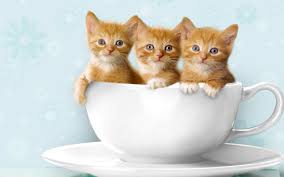
    cute kittens
    CUTE!
    kitten and puppy
    TOO CUTE!

    My granddaughter told me the other day, “Grandma, you think everything is ‘cute’.” To me, that indictment was a clear indication I had become word lazy and adjective deficient.  The fact that a 7th grader called me out was embarrassing. So, I did some research and came up with these alternatives to the word ‘cute.’

     lovable     ambrosial     appealing     attractive     captivating     charming
    darling     dear     delectable     delicious     delightful     dishy     dreamy     fetching     heavenly   hot     luscious     pleasing     precious     sexy     suave    nice looking   striking

     Now, when I look at this list, I can’t imagine these words were meant to substitute for ‘cute’ in every instance. However it’s a good start.

    What I learned from @lettergirl aka Dawn Cole at the #blogitsatx conference was a lesson taken to heart. She encouraged us to find new words, write them down and use them. Get out the Thesaurus and dictionaries and, above all, read.

    Next time my granddaughter and I talk, I’ll ‘wow’ her with my new words.


     Photo credit fanpop.com and collectionphotos.com


  • I just spent a week in Alexandria, Minnesota.  Daughter Maria, son-in-law Jason and baby Theodore Baron–a beautiful, healthy boy weighing in at close to 10 pounds at birth–made three good reasons to brave the frozen north for an inaugural visit. Even in mid-April the lakes are still iced over and a snow storm dumped at least six inches of beautiful white stuff during the week I was there.

    Besides playing grandma with the baby, I spent afternoons at the family business, Northland Woolens, Inc. Northland Woolens is a company that produces top quality woolen products made from recycled and all natural materials. Everything is produced in the shop located in Nelson, just down the road from Alexandria. I watched them wash recycled sweaters, make custom hats, cut mitten parts from recycled woolen materials, and pair and sew on cuffs. And, I saw the most amazing antique sock machines.

    View pictures on Flickr

    antique nordic sock machine